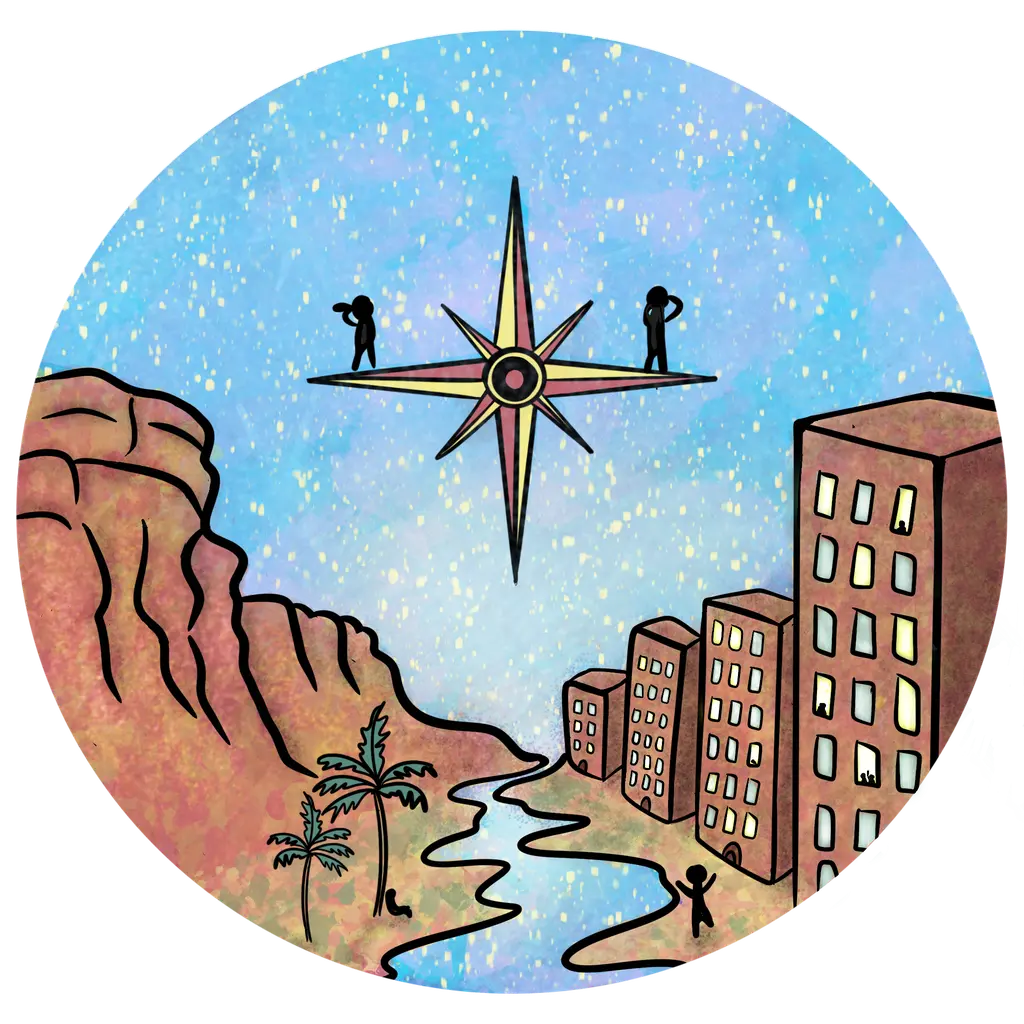
Children's geography is a subfield of human geography that takes up children and youth as its lens and subject. Children's geography explores how young people experience, perceive and imagine spaces and places, insisting that they are active agents in making meaning of the world around them. In this way, children's geography also functions as a pedagogical approach, including children's frameworks of knowledge in the curriculum and validating their everyday experiences as worthy of study in the classroom. Mary Biddulph explains:
Acknowledging and valuing what young people bring to the curriculum is one way of ensuring that the geography they learn is both meaningful and connected to their everyday lives; it is also the means by which we can build a bridge between young people and the mandated curriculum to ensure that the subject discipline, the geography that they learn, is a vehicle through which they make sense of their own lives as well as those beyond their immediate horizon.
The study of geography as a discipline in itself grounds us to our surroundings, both local and global. Geography offers our youth a way to position themselves in their worlds by bringing their surroundings to life through the study not only of our physical world but how we live, relate, develop, play and make meaning in it. Geography's big ideas are inherently place-based and involve ethical dimensions of thinking and decision making, frameworks that ground young people in criticality and care, and empower them as actors and citizens in their own local and global communities.
Geography underpins a lifelong ‘conversation’ about the earth as the home of humankind… It starts very early, when a young child encounters and begins to discover the world… Geography serves vital educational goals: thinking and decision making with geography helps us to live our lives as knowledgeable citizens, aware of our own local communities in a global setting.
Children's geography, then, insists that young people deserve a greater centrality both in our disciplinary thinking and in the curriculum. Young people need support in creating bonds of connection to their spaces and places to help nurture what was once a birthright and a matter of survival — a sense of belonging and stewardship.
Our Geographies of Home unit takes up the fundamental tenets of children's geography, namely centering the child's experiences, perceptions and imaginings of space and place, and makes them transdisciplinary by exploring them through art practices. Throughout this unit, learners will be exploring representations of place through the practice of mapping and the works of different artists, all of whom engage with what could be considered a place-based practice. Our unit aims to get learners to slow down and interact with their surroundings, both near and far, with criticality, curiosity, and care.
Works Cited
- Gritzner, Charles F. “What Is Where, Why There, and Why Care?” Journal of Geography, vol. 101, no. 1, Jan. 2002, pp. 38–40, doi.org/10.1080/00221340208978465.
- Hammond, Lauren. “Recognising and Exploring Children's Geographies in School Geography.” Children's Geographies, vol. 20, no. 1, 25 Apr. 2021, pp. 1–15, doi.org/10.1080/14733285.2021.1913482.
- Geographical Association. A Different View: A Manifesto from the Geographical Association. Geographical Association, 2009. roehampton.ac.uk/…/geographical-association-manifesto.pdf